

















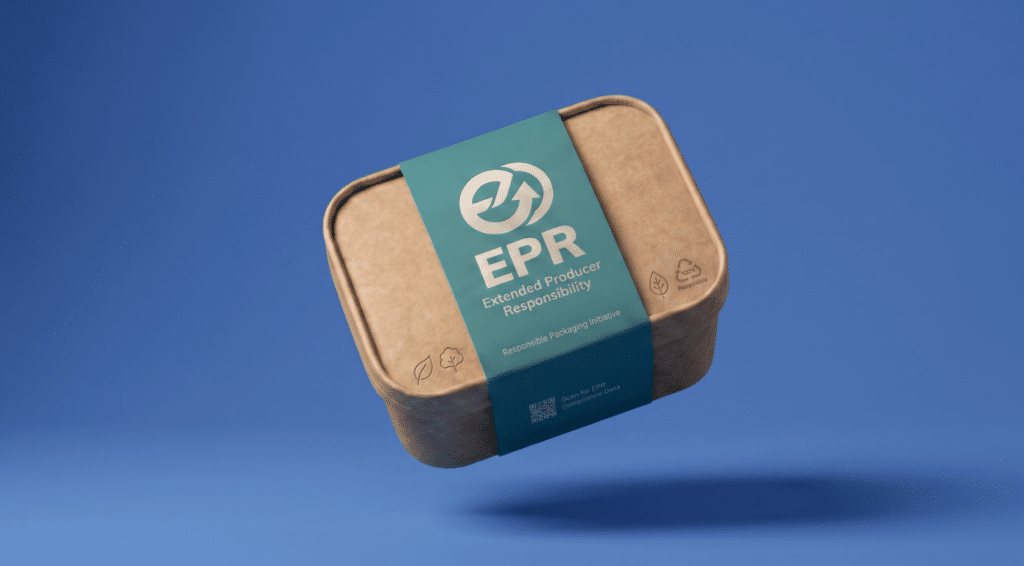
If your business handles more than 25 tonnes of packaging a year and your UK turnover sits above £1 million, you’re almost certainly obligated under Extended Producer Responsibility.
Since 2024, the rules have changed significantly for anyone who supplies, fills, imports, or sells packaged goods to the UK market.
This guide by Custom Pack Studio covers what packaging EPR actually is, who it applies to, what you need to report, and how the packaging choices you make today affect the fees you’ll pay.
What Extended Producer Responsibility Means
Extended Producer Responsibility is a policy approach that makes UK organisations financially responsible for managing the packaging waste they put into circulation.
Before EPR, the cost of collecting and recycling household packaging fell largely on local authorities, funded through council tax.
Under the new regime, those costs are shifted onto the businesses that supply packaging in the first place: the fees now cover managing household packaging waste through kerbside collections, recycling infrastructure, and consumer information programmes.
The Packaging and Packaging Waste Directive established producer responsibility principles across Europe.
The UK’s version has been updated with the 2024 scheme, phasing out the old Packaging Recovery Notes trading system in favour of a fee-based model that directly funds local authority waste management costs, though PRNs and PERNs still run alongside the new fees for now.
Fees are tied to the weight and recyclability of the packaging placed on the market.
Packaging EPR applies across all four UK nations and covers packaging placed on the UK market regardless of where it was produced.
Who Falls Under EPR
You will need to collect and report packaging data for any given year if:
- you are an individual business, group, or subsidiary.
- has an turnover of £1 million or more.
- carry out packaging activities.
- import or supply more than 25 tonnes of packaging to the UK market.
Your obligations under packaging EPR depend on which producer category you fall into.
For example, small producers have different obligations compared to larger producers.
The UK Government does allow exemption from obligations and fees for charities that produce packaging waste.
Large Producers and Small Producers: EPR Obligations Explained
A large producer is a business with a UK turnover of £2 million or more AND more than 50 tonnes of packaging per year.
Large producers have the fullest set of EPR obligations: twice-yearly packaging data submission and EPR fee payments based on the packaging they place on the UK market.
Small producers are businesses handling between 25 and 50 tonnes of packaging per year with a turnover above £1 million and up to £2 million.
They register and submit packaging data, but their fee obligations are lighter and some requirements phase in on a longer timescale.
Below 25 tonnes, or below the turnover threshold, you’re not obligated under EPR.
Calculating your tonnage is less straightforward than it sounds, it includes primary, secondary, tertiary, and shipping packaging.
The figure also can include supplying goods under your own brand, packing goods into packaging, importing packaging or packaged goods, selling via an online marketplace, and hiring or loaning out reusable packaging.
A trusted UK packaging supplier can help guide you through your EPR responsibilities to help you understand if you may need to take action.
Packaging Activities Covered by EPR
EPR obligations attach to several distinct packaging activities, and businesses frequently find they’re involved in more than one.
The main categories are:
- Filling packaging with goods (brand owners packing products for sale)
- Supplying empty packaging to other businesses
- Importing packaged goods or unfilled packaging into the UK
- Selling packaging or packaged goods directly to UK consumers as a brand owner, whether direct to consumers or through a retailer
- Operating an online marketplace where third-party sellers supply goods to UK buyers
The rules are designed so that every packaging activity that puts packaging onto the UK market has a named, financially responsible party.
Where multiple businesses could be counted for the same packaging, anti-double-counting provisions prevent requiring packaging producers to report the same packaging data twice.
Reporting Packaging Data
Once you’re obligated, data about the packaging your business handles must be collected and submitted regularly.
The packaging data must cover material type (paper, cardboard, plastic, glass, steel, aluminium, wood, fibre-based composites), packaging format (primary, secondary, shipment, tertiary), and the split between household and non-household packaging.
Inaccurate packaging data submission, whether through underreporting tonnage or misclassifying materials, puts the business at risk of enforcement action and fee adjustments.
The collection process needs to be systematic.
Secondary and tertiary packaging is a common gap: the wrapping film, pallet boards, and outer cartons that protect goods between factory and retailer often go uncounted until the data collection process forces businesses to tally every layer.
For businesses without dedicated environmental compliance resource, joining a packaging compliance scheme is a useful solution to ensure you stay safe and compliant.
Packaging compliance schemes handle registration, data collection, submission, and fee payment on your behalf, in exchange for a membership fee based on your packaging tonnage.
How EPR Fees Are Calculated
Recyclability of Packaging
EPR waste management fees apply to household packaging and are modulated based on recyclability under the Recyclability Assessment Methodology (RAM).
Packaging that is easier to recycle carries a lower fee.
The harder-to-sort formats, materials that don’t separate cleanly or can’t be processed through standard kerbside infrastructure, sit in a higher fee band.
Waste management fees are set annually and vary by packaging material.
The fee modulation creates a direct financial incentive to look at the recyclability of their packaging and make changes before costs accumulate.
A business using mono-material cardboard packaging will pay a lower EPR fee per tonne than one using packaging that contains mixed materials or components that can’t be separated at a sorting facility.
Across several hundred tonnes a year that gap becomes a meaningful annual cost difference.

Reusability of Packaging
Reusable packaging has its own category in the fee structure.
Packaging designed for multiple uses, returned and refilled rather than discarded after a single use, is treated differently from single-use packaging because its per-use environmental impact is lower.
Producer responsibility obligations for reusable packaging are structured to account for the reuse cycle rather than treating each unit as a single disposal event.
Household Packaging and Non-Household Packaging
Household vs. non-household isn’t about where packaging ends up or what waste contract collects it.
Secondary and tertiary packaging is almost always non-household.
Primary packaging is different: it counts as household by default, unless you can prove otherwise.
Using a private waste collection service doesn’t count as proof.
The classification only changes if the packaging is supplied directly to a business or institution that is itself the end user, or the product is designed purely for business use and unlikely to end up in a household or public bin.
This catches out food service businesses especially. Packaging handed to a paying customer, dine-in or takeaway, is still household packaging, because the customer is the end user, not the business serving them.
Because household is the default, the real task isn’t classification, it’s evidence. Sales data, contracts, and supply chain documentation need to be kept for at least 7 years to support any non-household claim.
Recyclability, Labelling, and Packaging Recycling
Beyond EPR, it is important for large producers to think about labelling as a voluntary way to help encourage correct consumer recycling behaviour, separate from any RAM or fee obligation.
Labels like widely recyclable, check locally, or not yet recyclable help consumers act correctly at the point of disposal.
Materials with clear, established recyclability lend themselves to confident “widely recyclable” labelling, while mixed-material or hard-to-assess packaging is harder to label with confidence.
If you are looking for ways to make your recyclability labelling more distinct, Custom Pack Studio can help you choose materials and formats that make confident, clear labelling easier to achieve.
How Your Environmental Packaging Choices Affect EPR Costs
All the packaging we produce at Custom Pack Studio is made from 100% recyclable materials.
Our cardboard boxes, from postal mailer boxes to reverse tuck-end cartons, use folding box board and corrugated materials that sit squarely in the widely recyclable category under UK EPR rules.
For businesses that are, or expect to become, obligated under packaging EPR, that matters in two ways.
You pay lower fees when your packaging passes the RAM recyclability assessment.
And you avoid having to respecify your packaging later to meet requirements your current materials don’t satisfy.
Fully recyclable cardboard packaging built to pass the RAM assessment from day one means no respecification work and lower fees on every tonne you report.
For businesses currently using packaging with plastic elements, laminated finishes, or non-standard material combinations, EPR fee modulation gives a clear financial reason to reconsider.
We can help work through what alternatives are available: a straight swap to a recyclable format, or a full redesign that does the same job in cardboard.
A design consultation is a good place to start, and there’s no minimum order if you want to trial a new format before committing.
Ready to Get Your Packaging EPR-Ready? Talk to Custom Pack Studio Today
If EPR is on your radar, or you’re reviewing your packaging materials with fees in mind, we’d be glad to help.
Our no minimum order means you can trial a new recyclable format without committing to a large run, and our team can help you spec packaging that’s on-brand and clearly positioned in the right fee band under UK EPR rules.
Call us on 01294 314 919, email contact@custompackstudio.co.uk, or request a free quote online. No minimum order required.