










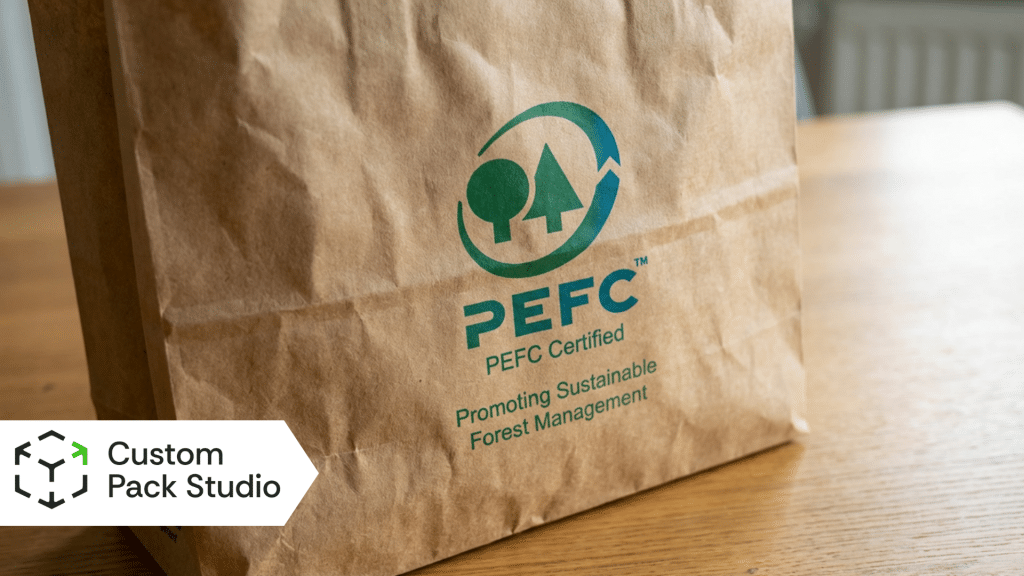
You have probably seen the PEFC logo on a cardboard box, a paper bag, or a label and wondered what it actually means.
Behind that small green logo sits an international certification system covering more forest than any other of its kind. It connects the board and paper in your packaging back to forests that are managed responsibly, and it does so through an audited supply chain rather than a marketing claim.
If you sell a physical product and your packaging is made from cardboard or paper, PEFC certification is worth understanding.
It affects the materials your packaging supplier uses, the claims you can make about your brand’s environmental credentials, and how your customers judge your commitment to sustainability.
What PEFC stands for
PEFC stands for Programme for the Endorsement of Forest Certification. It is an international, non-profit, non-governmental organisation that promotes sustainable forest management through independent third-party certification.
You might also see it described as an alliance of national forest certification systems, which is a fair summary of how it operates.
It was founded in 1999 by a group of European forest owners who wanted a way to prove their woodlands were being managed responsibly. The existing certification options at the time did not reflect local conditions or work well for smaller, family-run operations, so they built something that did.
Today, close to 300 million hectares of forest are managed in line with PEFC’s internationally recognised sustainability standards. And by their estimates, around 71% of all certified forests worldwide are certified under PEFC, making it the leading forest certification system globally.
How PEFC certification works
PEFC does not run one single set of rules that every forest in every country must follow. Instead, it works as a mutual recognition system.
Each participating country develops its own national forest certification standard, tailored to local priorities and conditions including geography, ecology, legislation, and forestry traditions.
These certification schemes are developed through multi-stakeholder processes involving forest owners, NGOs, labour unions, government bodies, and industry representatives. PEFC then assesses each national standard against its internationally recognised sustainability benchmarks to decide whether it qualifies for endorsement.
This matters because forests in Scotland face very different challenges to forests in Brazil or Indonesia. A one-size-fits-all system would either be too vague to be meaningful or too rigid to work in practice.

PEFC’s approach lets each country set standards that actually reflect the forests within its borders, while still meeting a consistent international baseline for environmental, social, and economic sustainability.
In the UK, the PEFC-endorsed national standard is managed through the UK Woodland Assurance Standard (UKWAS), which also underpins FSC certification in Britain. So when you see PEFC on packaging made from UK-sourced board, it traces back to woodlands managed under that same internationally accepted framework.
PEFC certification standards for sustainable forestry
PEFC says endorsed national systems must meet strict environmental, social, and economic requirements under its Sustainability Benchmarks. These are set out through detailed standards and criteria, not just broad principles.
Environmental protection and sustainability
Protecting biodiversity is at the centre of these requirements.
Certified forests must maintain natural habitats and safeguard water quality. Harvesting practices must allow the forest to regenerate naturally, and any replanting must use species appropriate to the local ecosystem.
The goal is that the forest continues to function as a healthy ecosystem, not just a source of timber. Soil health, carbon storage, and wildlife corridors all factor into how sustainable forests are managed over time. This is what sets responsible forest management practices apart from conventional logging.
Social responsibility
Forestry operations under PEFC must respect the rights of workers and local communities. That covers fair working conditions, health and safety protections, and open consultation with people affected by forestry activity.
In Scotland, this also extends to public access for recreation, which is well established under the Land Reform (Scotland) Act.
Long-term economic viability
A forest that is not financially sustainable will eventually face pressure to be sold off or converted to other land uses. PEFC addresses this by requiring that harvest rates stay within what the forest can replenish, and that management planning looks decades ahead rather than chasing short-term returns.
PEFC chain of custody: from forest to finished box
Certifying the forest is only half the picture.
For the PEFC label to appear on a finished product like a cardboard box or paper bag, every step between the forest and that product must be tracked and independently verified. This is called chain of custody certification.
And here is how it works in practice. A certified forest produces timber. That timber goes to a sawmill or pulp mill, which processes it into board or paper. The board then moves to a packaging manufacturer who prints and converts it into finished boxes, sleeves, or mailers.
At each stage, the company handling the material must hold its own PEFC chain of custody certificate. That certificate proves it can trace what it buys back to certified or controlled sources.
If any link in that chain is broken, the PEFC label cannot be used on the final product. The traceability is what gives the label its credibility.
It is an audited, documented trail connecting your forest-based packaging back to sustainably managed forests, verified by independent certification bodies at every stage.
What the PEFC label on packaging means
When you see the PEFC logo on a box or printed material, it tells you one of two things, depending on which version of the label is used.
PEFC Certified
This label means the product is made from material that comes entirely from PEFC certified forests, or from a mix of certified and controlled sources.
“Controlled sources” means the material has been verified as not coming from illegal logging, genetically modified trees, areas where traditional or civil rights are violated, or forests being converted to non-forest use.
PEFC Recycled
This label applies to products made from recycled material. The recycled content must meet PEFC’s requirements for traceability, and any virgin material in the mix must come from certified or controlled sources. For packaging, this is common because much of the cardboard and paperboard used in the UK already contains a proportion of recycled fibre.
Both labels are backed by independent audits. A company cannot simply print the PEFC logo on its certified products. It must hold a valid chain of custody certificate, subject to regular surveillance audits by accredited certification bodies.
This is a market-based mechanism that gives the label real weight. It can be withdrawn if standards are not maintained.
PEFC vs FSC: what is the difference?
This is one of the most common questions people ask when they start looking into sustainable packaging.
Both PEFC and FSC (Forest Stewardship Council) certify that wood and paper products come from responsibly managed forests, but they work in different ways.
FSC operates a single global certification standard.
Every forest seeking FSC certification is assessed against the same set of principles and criteria, regardless of where it is in the world. PEFC, by contrast, endorses national standards that are developed locally and then benchmarked against PEFC’s international requirements.
In practice, both systems deliver credible assurance that forest products come from responsible sources. And many forests hold dual certification under both schemes. For example, in the UK both rely on the same underlying standard (UKWAS).
The choice between FSC and PEFC labelling on finished products often comes down to what certification the board or paper supplier holds, and which chain of custody the packaging manufacturer has in place.
At Custom Pack Studio, we are proud to hold both PEFC and FSC certifications. This allows us to supply packaging under either scheme (or both schemes) depending on what you need.
Some retailers and brands specify one over the other in their procurement policies, and having both means we can work with whatever your supply chain requires.
Why PEFC certification matters for packaging
If your product comes in a cardboard box, that box started as a tree. The question is whether that tree came from a forest managed with the long term in mind, or from one that was harvested without regard for what comes next. PEFC certification is how you answer that question with evidence rather than guesswork.
Empowering consumers to choose responsibly
Customers increasingly want to know that the products they buy come from sustainably managed forests rather than contributing to deforestation. Demand for certification has grown because shoppers recognise that a verified label on packaging means something, while a vague “green” claim often does not.
The PEFC logo is understood internationally and carries weight with buyers who check these things before purchasing. It gives consumers a way to make responsible sourcing decisions at the point of sale.
Retailer and supply chain requirements
Many UK retailers now require or prefer suppliers to use certified materials. If you supply products to supermarkets, department stores, or large e-commerce platforms, PEFC or FSC certification on your packaging may be a condition of doing business rather than a nice-to-have.
Working with a PEFC-certified packaging manufacturer means you can meet those requirements without needing to manage the certification yourself.
Avoiding greenwashing
There is a growing backlash against vague environmental claims.
Saying your packaging is “eco-friendly” without evidence is risky, both from a reputational standpoint and increasingly from a regulatory one as advertising rules tighten around green claims.
PEFC certification gives you something specific and verifiable to point to. It is backed by independent audits, not marketing copy.
Protection of forests and timber resources
Forests cover around 31% of the world’s land area. They store carbon, support biodiversity, regulate water cycles, and protect soil.
The protection of forests in Europe and globally depends on responsible practices being the norm rather than the exception. Certification schemes like PEFC help make that happen.
The timber still gets harvested and turned into board. But the forest stays healthy and productive for the next generation, and the one after that.
How Custom Pack Studio uses PEFC certified materials
We are a PEFC chain of custody certified manufacturer. That means the board and paper we use to produce custom packaging can be traced back to certified forests through an independently audited supply chain.
When you order packaging from us, you can request PEFC-certified stock.
We will supply it with the appropriate documentation, and if you want to display the PEFC logo on your packaging, we can guide you through the requirements for on-product labelling. There are rules around how and where the logo can appear, and we handle that as part of the design process.
By working with us, you (and your customers) can feel confident your packaging comes from responsibly sourced materials and is being handled compliantly.
How to check if your packaging is PEFC certified
If you already have packaging and want to verify whether it carries genuine PEFC certification, there are a few things to look for.
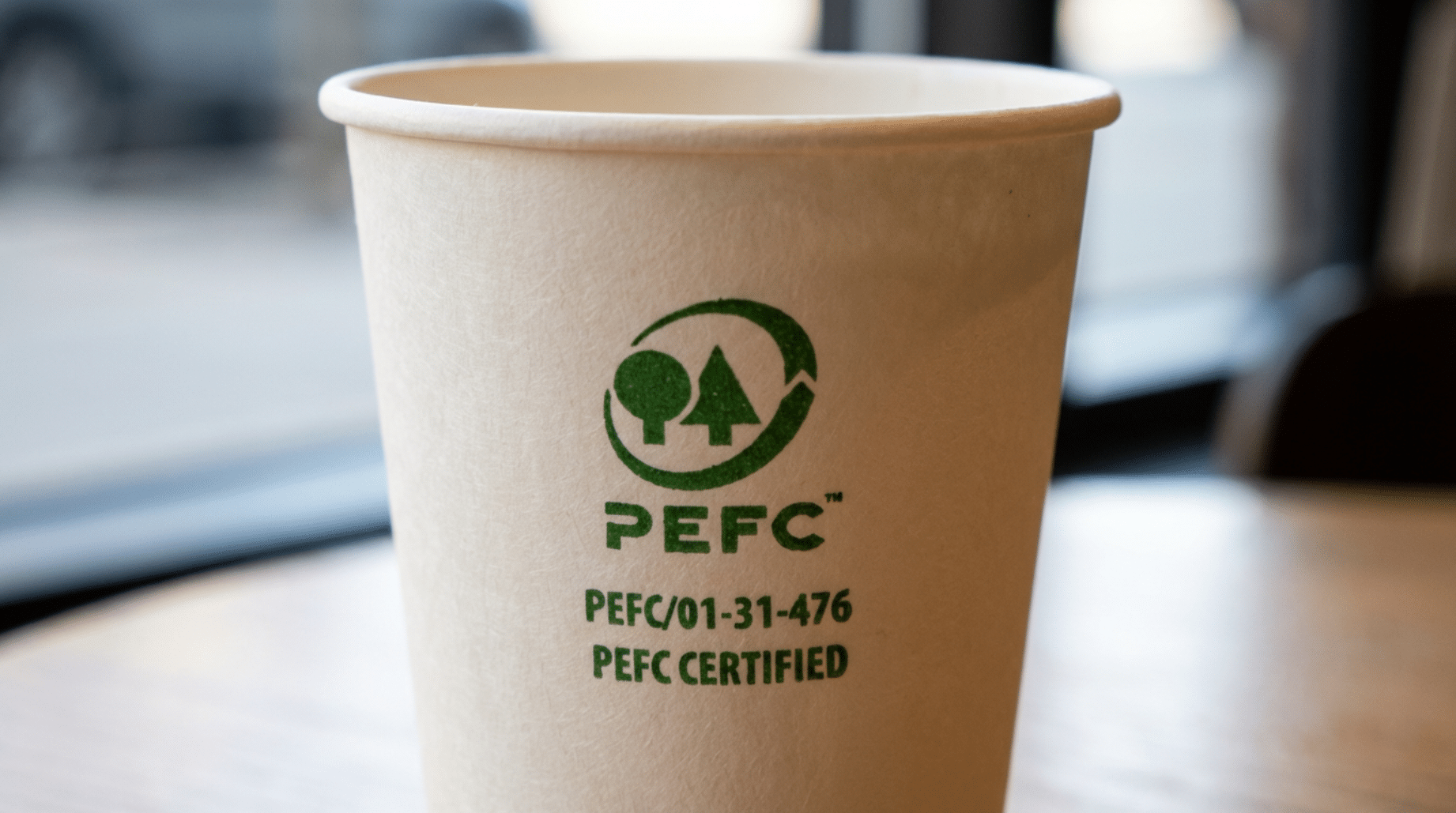
The PEFC logo should include a licence number, usually starting with “PEFC/”. You can check that number on the PEFC website to confirm the certificate is valid and current.
If the logo appears without a licence number, or if the design does not match PEFC’s official specifications, it may not be legitimate.
You can also ask your packaging supplier for their chain of custody certificate directly. Any certified supplier should be happy to provide this on request, along with documentation showing the certification status of the materials they use.
If your current supplier cannot provide this, it is worth asking why
Frequently asked questions
What does PEFC stand for?
PEFC stands for Programme for the Endorsement of Forest Certification. It is the world’s largest forest certification system.
Is PEFC the same as FSC?
They are different organisations with different approaches, but both certify that wood and paper products come from responsibly managed forests. FSC uses a single global standard, while PEFC endorses national standards benchmarked against international requirements.
In the UK, both systems rely on the same underlying standard (UKWAS), and many forests hold dual certification.
Can I put the PEFC logo on my packaging?
Yes, but only if your packaging is produced by a PEFC chain of custody certified manufacturer using certified material. There are specific rules about how the logo must appear, including size, placement, and the inclusion of a licence number.
We handle this as part of the design process when you order PEFC certified packaging from us.
Does PEFC certification mean the packaging is recyclable?
PEFC certification relates to where the raw material comes from, not what happens to the packaging at end of life. However, most PEFC certified packaging is made from cardboard or paperboard, which is widely recyclable across the UK.
Why should I choose PEFC certified packaging for my brand?
It gives your customers verifiable proof that the materials in your packaging come from responsibly managed forests. It also protects your brand from greenwashing accusations, because PEFC certification is independently audited rather than self-declared.
Is PEFC certification recognised in the UK?
Yes. PEFC is fully recognised in the UK, and the UK Woodland Assurance Standard (UKWAS) is the endorsed national scheme. PEFC certified products meet the timber procurement requirements of UK government and many major retailers.
Choose packaging you can trace back to the forest with Custom Pack Studio
PEFC certification is one of the most straightforward ways to ensure your packaging materials come from forests that are managed with the long term in mind. It is not a marketing badge. It is an audited, traceable system that connects your finished box back to a responsibly managed woodland.
At Custom Pack Studio, we hold both PEFC and FSC chain of custody certification, and all our packaging is 100% recyclable. Whether you need 50 boxes or 5,000, we can supply them in PEFC certified stock with the documentation to prove it.
If you are looking for a packaging partner who is committed to caring for the enivornment as much as your brand, get in touch with our friendly team today on 01294 314 919 to talk through your requirements.